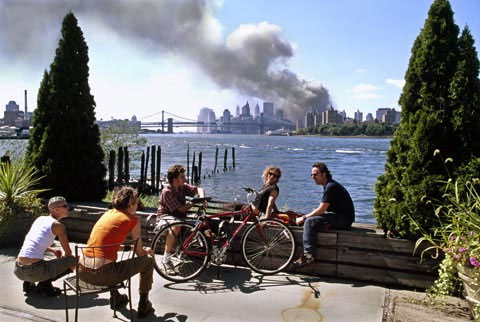
There's this photo that's been floating around the internet in a hurry lately, a big topic since Monday, which was of course the anniversary. In the photo, a group of five apparent-twentysomethines are sitting on a wall in Williamsburg, lounging in the sunshine and chatting. Behind them is the lower Manhattan skyline, where two enormous clouds of smoke are billowing in the group's direction. It's 9/11 of course, and here are your classic jaded young people, straight out of Dave eggers, too self-absorbed to even look at history happening behind them.
At least, that's what the photographer wants you to think. Since showing up in Frank Rich's column earlier this week, the photo has been weighed in on across the internet, even earning its own Gawker poll. Finally today one member of the group spoke up-- not so young, it turns out, he's 40-- to answer, yes, of course we were talking about it. He pointed out that if the photographer had just walked 50 feet forward, he could have learned that for himself, instead of simply drawing his own conclusions.
Misinterpretation like this is de rigeur with any kind of surveillance, even in a time of tell-all blogs and full-color security camers. When we observe the lives of other people, there is always room for conjecture, educated guess. What hapepned before we turned the camera on? What did he just whisper? From observing animal behavior to prison surveillance to photographing a group of people from 50 feet away, whatever is not crystal clear is open to interpretation.
Frank Rich wrote of the group that they're not callous, chatting idly during a mind-boggling tragedy-- they're just American. They move on, looking to the future. As for Frank Rich, he's not a liar or a fool, placing his own assumptions on unwilling subjects-- he's just human. In everything we observe and experience we want to see ourselves, from a puppy who "kisses" to the perfect song on the radio that matches your mood.
This is why we watch people, why surveillance has made the leap from governmental privilege to national pastime. We watch for ourselves or what we want to believe, and when we find it we sit back satisfied, knowing we were right all along. If someone comes along with another idea, even the person we were watching to begin with, it no longer matters- whatever we've found is already ours, a symbol for what we wanted, beyond fact or reason.
I remember reading once-- Chuck Klosterman, maybe-- about a screaming match that occurred during the first season of "The Real World," in New York. A black man and a white woman were in a heated argument about racism. a scene that has since become part of every "Real World" season since. What was left out in the editing of this fight, apaprently, was that the conversation took place immediately after the Rodney King beatings, a time when everyone in America was having heated arguments abotu racism. This time Frank Rich could have been right-- they were being histrionic, they were just being American. But by the time the fight aired it was too late-- these two kids had already set the template for generations of hot-tempered twentysomethings to come. The argument was no longer theirs but a symbol with entirely different meaning, in an entirely different person's hands.
It's been shown to us for centuries in art-- Marilyn, when screenprinted, is not just a girl but all of America; a broken set of pince-nez glasses in the hands of Sergei Eisenstein becomes the despair of the proletariat. A pipe is not a pipe. Now that we have so blatantly focuses the lens and paintbursh on ourselves-- no more cloak of fiction, just straight-up reality-- how can we complain when we ourselves become co-opted and distorted by someone else's idea? In putting ourselves out there, whether trying otu for a reality TV show or setting up a MySpace account, we subject ourselves to the opposite of the individuality we may be trying to express: we become someone else's symbol, representative of something we may not even like.
Or sometimes, as with a few people on the waterfront one day in September, we don't even have to put ourselves out there. In a world of "citizen journalists," where everyone believes they're just a few extended metaphors away from Frank Rich, we may all be up for scrutiny and symbolism whether we like it or not. It's bold, certainly. Some might even call it brave. It's a new world, indeed.
skip to main |
skip to sidebar
Just another bus-riding, canvas bag-toting, blister-sporting, iPod-listening New York twentysomething starting a blog. Except maybe I'm a little cuter.


No comments:
Post a Comment